Tuesday, 24 January 2012

Anniversary of the Death of Sir Winston Churchill -- Sir Robert Menzies' tribute

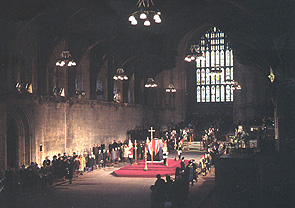
Sir Winston Spencer Churchill lying in state in Westminster Hall
On this day, the anniversary of his death in 1965, we remember with undying gratitude the life and legacy of a giant of history: Sir Winston Spencer Churchill.

Many great figures have paid tribute to Sir Winston, the greatest statesman of the Twentieth Century, and the man voted "Greatest Briton" by the nation in 2002; however, the tribute that I have always found most moving was delivered by Australia's illustrious Prime Minister, Sir Robert Menzies, on the day of Sir Winston's state funeral.

I post it below as my tribute to the Great Man on the anniversary of his death:


A Tribute by Sir Robert Menzies KT, CH, QC, MP
given on the occasion of the State Funeral of Sir Winston Churchill
January 30, 1965

‘ONE FIRE BURNING IN HIM'

As this historic procession goes through the streets of London to the Tower Pier, I have the honour of speaking to you from the crypt of St Paul's Cathedral. I do this in two capacities. One is that I, Prime Minister of Australia, happen to be, in point of time, the senior Commonwealth Prime Minister, and therefore speak on behalf of a remarkable world organization which owes more that it can ever express to our departed leader, Sir Winston Churchill. He is one of the famous men whom we thank and praise.

My second capacity is more personal and more intimate. I am sure that you, most of you, have thought about Sir Winston Churchill a great deal, and with warmth in your hearts and in your recollections. Some day, some year, there will be old men and women whose pride it will be to say: ‘I lived in Churchill's time'. Some will be able to say: ‘I saw him, and I heard him - the unforgettable voice and the immortal words'. And some will be able to say: ‘I knew him, and talked with him, and was his friend'.

This I can, with a mixture of pride and humility, say for myself. The memory of this moves me deeply now that he is dead, but is gloriously remembered by me as he goes to his burial amid the sorrow, and pride, and thanks, of all of you who stand and feel for yourselves and for so many millions.

Many of you will not need to be reminded, but some, the younger among you, the inheritors of his master-strokes for freedom, may be glad to be told that your country, and mine, and all the free countries of the world, stood at the very gates of destiny in 1940 and 1941 when the Nazi tyranny threatened to engulf us, and when there was no ‘second front' except our own. This was the great crucial moment of modern history. What was at stake was not some theory of government but the whole and personal freedom of men, and women, and children. And the battle for them was a battle against great odds. That battle had to be won not only in the air and on the sea and in the field, but in the hearts and minds of ordinary people with a deep capacity for heroism. It was then that Winston Churchill was called, by Almighty God, as our faith makes us believe, to stand as our leader and our inspirer.

There were, in 1940, defeatists, who felt that prudence required submission or such terms as might be had. There were others who, while not accepting the inevitability of defeat, thought that victory was impossible. Winston Churchill scorned to fall into either category, and he was right. With courage, and matchless eloquence, and human understanding, he inspired us and led us to victory.

In the whole of recorded modern history, this was, I believe, the one occasion when one man, with one soaring imagination, with one fire burning in him, and with one unrivalled capacity for conveying it to others, won a crucial victory not only for the forces (for there were many heroes in those days) but for the very spirit of human freedom. And so, on this great day, we thank him, and we thank God for him.

There are two other things I want to say to you, on a day which neither you nor I will ever willingly forget. One is that Winston Churchill was not an institution, but a man; a man of wit and chuckling humour, and penetrating understanding, not a man who spoke to us as from the mountain tops, but one who expressed the simple and enduring feelings of ordinary men and women. It was because he was a great Englishman that he was able to speak for the English people. It was because he was a great commonwealth statesman that he was able to warm hearts and inspire courage right round the seven seas. It was because he was a great human being that, in our darkest days, he lit the lamps of hope at many firesides and released so many from the chains of despair. There has been nobody like him in our lifetimes. We must, and do, thank God for him, and strive to be worthy of his example.

The second thing I will never forget is this. Winston Churchill's wife is with us here in London; a great and gracious lady in her own right. Could I today send her your love, and mine? She has suffered an irreparable personal loss. But she has proud and enduring memories. Happy memories, I venture to say. We share her sorrow, but I know that she would wish us to share with her those rich remembrances which the thought of the great man evokes.

There have been, in the course of recorded history, some men of power who have cast shadows across the world. Winston Churchill, on the contrary, was a fountain of light and of hope.

As I end my talk to you from the crypt of St Paul's, with its reminders of Nelson and Wellington, those marvellous defenders of long ago, the body of Winston Churchill goes in procession through the streets of London; his London, our London, this most historic city, this ancient home of freedom, this place through which, in the very devastation and fire of war, his voice rang with courage, and defiance, and hope, and rugged confidence.

His body will be carried on the Thames, a river full of history. With one heart we all feel, with one mind we all acknowledge, that it will never have borne a more precious burden, or been enriched by more splendid memories.

Thursday, 19 January 2012

Churchill's view of Italian Cruise Ships

The following anecdote has been wildly circulating around the Internet in the days following the tragic Costa Concordia cruise ship disaster. However, no evidence can be found to sustain its authenticity as a genuine Churchill anecdote. The most popular version, is found in "The Wit and Wisdom of Winston Churchill by James C. Humes" but, again, no original source can be found to support the anecdote, and there is no record of Churchill taking an Italian cruise ship "late in life".


From "The Wit and Wisdom of Winston Churchill" by James C. Humes:

"Late in his life, Sir Winston took a cruise on an Italian ship. A journalist from a New York newspaper approached the former prime minister to ask him why he chose to travel on an Italian line when the Queen Elizabeth under the British flag was available.

Churchill gave the question his consideration and then gravely replied.

'There are three things I like about Italian ships. First, their cuisine, which is unsurpassed. Second, their service, which is quite superb. And then - in time of emergency - there is none of this nonsense about women and children first.'

Tuesday, 17 January 2012

280th Anniversary of the Birth of the Last King of Poland

Today is the 280th anniversary of the birth of the last King of Poland, Stanislaw II August (Poniatowski), by the grace of God, King of Poland, Grand Duke of Lithuania and Duke of Ruthenia, Prussia, Masovia, Samogitia, Kiev, Volhynia, Podolia, Podlasie, Livonia, Smolensk, Severia and Chernihiv. King Stanislaw was the founder of the (extinct) Order of St. Stanislaw in 1765 and the (extant) Order of Virtuti Militari in 1792.

Forced to abdicate upon the partition of Poland by Prussia, Russia and Austria in 1795, King Stanislaw moved to St. Petersburg, where he died in 1798. His body was transferred to St. John's Cathedral in Warsaw in 1995.

A patron of the arts, King Stanislaw had intended to create a magnificent Polish Royal Collection and commissioned two London dealers to form the collection. The dealers spent five years touring Europe to acquire paintings however, due to the country's partition and the King's abdication, the paintings never reached Poland and remained with the dealers in England. The surviving partner eventually bequeathed the collection to Dulwich College in London, where they became the foundation of the Dulwich Picture Gallery and may be seen to this day.

HM The King of Spain confers the Order of the Golden Fleece upon the President of France

On Monday, 16th January 2012, at the Royal Palace in Madrid, King Juan Carlos of Spain bestowed the Most Illustrious Order of the Golden Fleece upon French President Nicolas Sarkozy. Founded by Philip III "The Good", Duke of Burgundy in January 1430, the Order of the Golden Fleece is Europe's greatest dynastic order. There is also an Austrian Order of the Golden Fleece (of which the head is HI&RH Archduke Karl von Habsburg).

French President Nicolas Sarkozy and HM The King of Spain flank the collar of
the Order of the Golden Fleece. HM The Queen of Spain is in the background.
The President of France wearing the miniature of
the Order of the Golden Fleece

Sunday, 8 January 2012

The 30th Birthday of The Duchess of Cambridge - my TV interview

A short interview on Canadian television, via Skype, in which I discuss the milestone 30th birthday of The Duchess of Cambridge as well as the charities of which HRH is now patron. (Thanks to AussieCrown for technical assistance)

Saturday, 7 January 2012

Duchess of Cambridge's 30th birthday plans revealed

As the Duchess of Cambridge approaches her 30th birthday on Monday, she has opted for a low-key celebration with family and friends.


The duchess, formerly known as Kate Middleton, is spending a quiet weekend with the people she loves ahead of her milestone 30th birthday, royal watcher Rafal Heydel-Mankoo told CTV News Channel in an interview Saturday.


According to the editor of Burke's World Orders of Knighthood, the new royal's every move has been scrutinized since she married Prince William in a lavish ceremony last April.


With the eyes of the world following her every move, Heydel-Mankoo said the duchess has decided on a modest birthday celebration after a big New Year's Eve bash at the couple's estate.


Royal watchers and the public are also analyzing Kate's recent charity patronage picks. She has taken on honorary positions with four charities that deal with a range of causes, including drug addictions and disadvantaged youth.
Kate is now a royal patron of Action on Addiction, East Anglia's Children's Hospice, The Art Room and the National Portrait Gallery. She will also volunteer with the Scout Association.


Heydel-Mankoo said that's just "the first step of a long road."


Kate's father-in-law, Prince Charles, is involved with 400 charities. And in his day, Queen Elizabeth II's husband, the Duke of Edinburgh, was involved with a whopping 700 charities


The duchess "took a lot of time to research her charities" and make sure they align with her interests, Heydel-Mankoo said.


But some have criticized her picks as being "too safe" in comparison to the late Princess Diana's work with AIDS victims and her efforts to clear land mines in conflict zones.


Heydel-Mankoo said while comparisons to the legendary princess are inevitable, it makes sense for Kate to start off with some "sensible" charities and progress from there.


The British monarchy is trying to lead by example in charitable giving, Heydel-Mankoo said, and the duchess will elevate the profiles of the charities she has chosen to support.


It's a good way to step into her royal role as the family prepares for a busy year ahead, including the Queen's Diamond Jubilee, he added.


Source: http://www.ctv.ca/CTVNews/TopStories/20120107/Duchess-of-cambridge-birthday-plans-revealed-120107/#ixzz1ioUkg9V1

Monday, 2 January 2012

London's Finest New Year's Eve Celebration

In decades past, London wasn't regarded as a global "centre" for New Year's celebrations. All of that changed with the creation of the "London Eye". Since its erection, London has generally ranked amongst the "Top 3" New Year's Eve destinations for the quality of its fireworks display. 2012 is of course the year of HM The Queen's Diamond Jubiulee and the 2012 London Summer Olympics; consequently , there can be little surprise that London pulled out all the stops to make this the best New Year's Eve fireworks display of all time. Starting with the awesome sight of the Clock Tower of the Parliament Buildings exploding with each chime of Big Ben, the fireworks display continued for a full 12 minutes, centred on the London Eye. It has been ranked as the world's best fireworks display heralding the start of 2012. You may judge for yourself: 

Thursday, 29 December 2011

Knights of Malta Christmas Concert with Rupert Everett / Polish Air Force tribute

Earlier this month, a special Christmas carol concert was held at the historic Church of St. Clement Danes (Central Church of the Royal Air Force) in The Strand, London. The concert was organised by the Polish Order of Malta Volunteers (UK) in support of the fundraising initiative to support the Knights of Malta's highly successful oncological clinic in Poznan, Poland. Each year the clinic's 60 volunteers diagnose and treat, at no charge, over 5,000 patients. Medical departments include oncology, radiology, cardiology and surgery.  
Rafe Heydel-Mankoo discussing the history of the Polish Air Force
and its contribution to the RAF's victory in the Battle of Britain


Rupert Everett
The guest readers at the evening were the award-winning actors Rupert Everett (My Best Friend's Wedding, Pygmalion etc.), Sophie Thompson (Four Weddings and a Funeral, Gosford Park, Eastenders, etc. and sister of Emma Thompson) and Phyllida Law (Peter's Friends, Dixon of Dock Green, Rumpole of the Bailey etc. and mother of Emma Thompson).


Sophie Thompson

Phyllida Law


The concert consisted of a selection of Polish and English carols sung by Britain's foremost Polish choir, the Ave Verum Choir, accompanied by a string quartet.


This historic church of St. Clement Danes, the Central Church of the Royal Air Force, whose walls are scarred by the marks of shrapnel from the Blitz, provided the perfect setting in which to celebrate not only a Polish Christmas Night but also to mark the continued friendship between the British and Polish peoples. For St. Clement Danes also contains an important memorial to the Polish Air Force, including the badges of the 16 Polish squadrons that valiantly fought in the Battle of Britain and throughout the Second World War, and without whom victory might have been far from certain. During the Battle of Britain, the Polish 303 Squadron was the most successful Fighter Command unit in the Royal Air Force and one of its pilots was the most successful pilot in the entire Second World War.

Air Chief Marshal Sir Hugh (later Lord) Dowding, whose statute stands outside the Church of St. Clement Danes, would later write: "Had it not been for the magnificent material contributed by the Polish squardrons and their unsurpassed gallantry, I hesitate to say that the outcome of the Battle of Britain would have been the same."


Consequently, a special ceremony of commemoration was held during the concert. Colonel Andrzej Jeziorski, a former Second World War fighter pilot and past Chairman of the Polish Air Force Association, processed down the nave of the church with a young boy, representing British youth, to place a candle on the Polish Air Force Memorial, in tribute to the Poles valiant contribution to the fight for freedom. The memorial contains the same inscription as that inscribed upon the main Polish Air Force memorial which was unveiled in Northold in 1948: "I have fought a good fight. I have finished my course. I have kept the faith."

Colonel Andrzej Jeziorski, former WWII fighter pilot and past Chairman of the Polish Air Force Association
processes to the Polish Air Force Memorial with Alex Meeson, representing British youth.


Polish Air Force Memorial at St. Clement Danes


Saturday, 24 December 2011

70th Anniversary of Churchill's Christmas Speech at the White House

70 years ago today, on the 24 December 1941, less than three weeks after the bombing of Pearl Harbor by Japanese forces, the President of the United States and the Prime Minister of the United Kingdom stood shoulder-to-shoulder by the Christmas tree on the lawn of the White House in Washington, DC. Recognising that the future of Western Civilisation depended on the unity of the English Speaking Peoples and an alliance between the British Empire and the American Republic, Winston Churchill and Roosevelt combined their Christmas greetings with words of inspiration for the populations about to embark upon the long and arduous road to victory. To mark the anniversary I post the fully White House Christmas Tree ceremony below. Churchill's 5 minute speech commences at the 16 minute mark.


A Festival of Nine Lessons & Carols, Christmas Eve, King's College Chapel, University of Cambridge

"A Festival of Nine Lessons and Carols is the Christmas Eve Service held in King's College Chapel at the University of Cambridge. The Festival was introduced in 1918 to become a more imaginative approach to worship." lt was firsat broadcast in 1928 and has since become a global tradition and is broadcast to millions of people around the world." I well recall listening to the serene sound from far and distant Canada.
"The service includes carols and readings from the Bible. The opening carol is always 'Once in Royal David's City'" Source: http://www.youtube.com/watch?v=NMGMV-fujUY&feature=related


Wednesday, 21 December 2011

Baroness Trumpington demonstrates the Blitz spirit.

And in lighter news... It is well known that a gentleman should never refer to the age of a lady (or, indeed, "Lady") ... but perhaps some Lords need to be reminded of this strict rule of etiquette.

In this short video clip (which may be viewed by clicking on the image below) Baroness Trumpington, the last member of the House of Lords to have served in the Second World War (she was a code breaker at Bletchley Park), takes particular exception to former Cabinet minister Lord King's reference to her age -- resulting in Her Ladyship's uniquely British response.


Reflecting on the incident and her colourful gesture Baroness Trumpington said "to my horror [Lord King] suddenly said, more or less, even the people who worked in the last war are starting to look very, very old. I thought 'to hell with that'...I did actually raise two fingers and I tried to pretend my hand had slipped but it was going to be quite obvious that my hand had not slipped and I meant it."

The formidable Baroness Trumpington has a royal connection: she was a member of the Royal Household as a Baroness-in-Waiting and was appointed a DCVO in 2005.


Thursday, 15 December 2011

All Hallows-by-the-Tower -- London's "Canadian Church"

[This post is written to mark the anniversary of the visit to All Hallows-by-the-Tower of HRH The Prince of Wales (later Edward VIII) on 15 December 1923, following his tour of Canada.]

Founded by the Saxon Abbey at Barking in 675 (and long known as All Hallows Barking), All Hallows-by-the-Tower (so named for its proximity to The Tower of London), can rightly claim the status of "Canada's Church in London".

The Church of All Hallows-by-The-Tower, is one of London's least explored gems, with its extant roman foundations, atmospheric crypt, tiny underground chapels and historic associations -- from "hatch" (baptism of William Penn) to "match" (marriage of John Quincy Adams) to "dispatch" (burial of Archbishop William Laud). It was from the spire of All Hallows that the famous diarist Samuel Pepys briefly watched the Great Fire of London. Destroyed during the Blitz in 1940, All Hallows' restoration was due to tremendous assistance from Canada.

British Columbian wood was used in the construction of the spire of All Hallows, whilst the carillon of 18 bells was donated by J.W. McConnell of Montreal. The pews were donated by Canadian Pacific and the Province of Manitoba, whilst the Building Products Council of Montreal supplied the floor tiles.

The Lady Chapel of the Church, which is located at the north of the church, bears what is probably Britain's only stained glass reference to the University of Toronto. The window was erected by Canadian friends of Dr. Hugh Hornby Langton (1862-1953).

The window depicts Dr. Langton's arms along with the following inscription:

"Doctor Hugh Langton of Toronto University died 1953 a benefactor of Toc H 11 Toronto. His brother-in-law Major Edmund Street, D.S.O. was the first officer to enter Talbot House, Poperinghe, on 14th December 1915. His sword was brough back and laid up within this Chapel by HRH The Prince of Wales, on the 15th day of December 1923 after his Canadian Tour. This panel was given by Canadian Friends."

Dr. Langton, a graduate of the Unviersity of Toronto, was also its first full-time Registrar (1887-1892) and, upon retirement, became its librarian (1892-1923). A prolific author he also wrote a history of the "University of Toronto and its Colleges" and was the editor of the Chronicles of Canada and of the Review of Historical Publications Relating to Canada (which became the Canadian Historical Review)

I would encourage any Canadian visiting London to make the effort to visit this historic church, easily located approximately 90 seconds walk from Tower Hill underground station.


Sunday, 11 December 2011

Death of His Eminence Cardinal Foley, Grand Master Emeritus of the Order of the Holy Sepluchre

H.E. Cardinal Foley as Grand Master of the Equestrian
Order of the Holy Sepulchre
It was announced today, December 11th, that His Eminence, Cardinal John Patrick Foley, Grand Master Emeritus of the Equestrian Order of the Holy Sepulchre of Jerusalem, Cardinal-Deacon of S. Sebastiano al Palatino and former President of the Pontifical Council for Social Communications, has died aged 76 at the Villa St. Joseph in Darby (where he was born) outside Philadelphia, PA.

Cardinal Foley will be fondly remembered by Americans as the "voice" of the annual televised broadcast of the Midnight Mass from the Vatican, a role he performed for 25 years.

Elevated to the cardinalate in the 2007 consistory, Cardinal Foley was an archbishop for 27 years and a priest for 49 years -- H.E. would have celebrated the Golden Jubilee of his entry to the priesthood in 2012. Appointed a Knight with the Collar of the Equestrian Order of the Holy Sepulchre of Jerusalem in 1991, Cardinal Foley was appointed Grand Master of the Order in 2007, retiring as Grand Master Emeritus in 2011.

Cardinal Foley was also a Commander Grand Cross of the Order of the Northern Star (Sweden), a Grand Cross of the Order of Bernardo O'Higgins (Chile) and a Grand Cross of the Order of the Liberator General San Martin (Argentina).  R.I.P. -- Abiit ad Plures

The Heraldic Achievement of Cardinal Foley.
 His Eminence's arms, which are quartered with those of
The Equestrian Order of the Holy Sepulchre of Jerusalem, are also resting upon
the Cross of the Order.

Britain & the EU threat - Margaret Thatcher relives Churchill's "Wilderness Years"

There are so many reasons to admire and respect Churchill, but, for me, his defining period was his "Wilderness Years", isolated from his party and the general public, increasingly unpopular and out-of-step on India and his willingness to back Edward VIII during the Abdication Crisis. Churchill was dismissed as yesterday's man. Yet it was at this time that he, almost uniquely, recognised that the greatest threat to European security was Nazi Germany. His speeches in the 1930s made for sober reading in the 1940s.

Churchill sprang immediately to mind when, today, I chanced upon some of the speeches delivered by Lady Thatcher (then Mrs. Thatcher) in the 1990s.  Listening to Thatcher denounce the European Union and its dream in 1992, 93 or 94, I couldn't help but reflect on the prophetic similarity with Churchill.  Like Churchill, Thatcher was disdainfully dismissed as an out-of-date confrontational reactionary. Twenty years later, her comments sound extremely prescient and entirely prophetic.

I post two such examples for your consideration, the first contains her inflammatory speech at The Hague in 1992 in which she spookily forecasts precisely what we are experiencing now: high unemployment and national resentment. 


In the second interview she attached the system of European diplomatic negoation (for which direct comparisons may be drawn to the negotiations that took place during the recent EU summit) and why they are wrong and she is right: 


80th Anniversary of the Statute of Westminster, 1931

Today is the 80th anniversary of the Statute of Westminster, 1931, the Act of the United Kingdom Parliament that established legislative equality between the UK and all of the self-governing dominions within the British Empire. Although Canadians (1867), Australians (1788) and New Zealanders (1840) claim different years of foundation and choose to celebrate their national "Dominion/Canada Day", "Australia Day" and "Waitangi Day" birthdays on the anniversary of this foundation date (Canada - 1 July, enactment of the British North America Act, a.k.a. the Constitution Act, 1867; New Zealand - 6 February, signing of the Treaty of Waitangi; and Australia - 26 January, the proclamation of British sovereignty upon the landing of the British First Fleet in Sydney Cove) the more accurate "Independence Day" for these nations is today, 11th December (although it should be noted that, whilst the Statute automatically applied to Canada, South Africa and the Irish Free State, it had to be ratified separately by the parliaments of Australia, New Zealand and Newfoundland).

As has been discussed previously on this blog, the Statute was also a landmark document in terms of the Succession to the throne, enshrining the principle of the unity of the Crown and outlining, through its (albeit unenforceable) preamble, the importance of cooperation and unanimity between the realms in order to successfully enact any changes to the succession. This principle was tested less than 5 years later, during the Abdication Crisis of King Edward VIII. Although the Statute's continuing relevance is greatly reduced (and in many cases non-existent), by granting full independence to the self-governing dominions it is arguably the most important piece of legislation of the twentieth century.

Alas, despite such fundamental importance, the anniversary of its enactment has always been a non-event -- this is regrettable, as its annual celebration could have provided yet another visible and unifying link between the Commonwealth realms.

Nevertheless, since 1965 Canada, that Most Loyal Realm (MLR), has flown the Royal Union Flag (which remains an official flag of Canada to be flown on specific dates throughout the year -- where physical arrangements allow, i.e., there is a second flag pole) on 11th December in commemoration of the signing of the Statute of Westminster.  The Union Flag has been an official flag of Canada since 1904, indeed, it was the Union Flag and not the Red Ensign that was the official flag until the introduction of the Maple Leaf in 1965. The Royal Union Flag's current official status is as a symbol of membership in the Commonwealth and allegiance to the Crown, as decreed by the Canadian parliament on 18 December 1964.

Previous Canadian governments have treated this protocol requirement as something of an embarrassment and the date has often passed unmarked. I know many a staunch monarchist who has glumly reported various government buildings with unadorned second flag poles.

To its credit, and in keeping with its clear policy of celebrating Canadian heritage (including the Monarchy, etc.) the current Harper government has formally decreed that to mark the 80th anniversary of the signing of the Statute of Westminster, the Royal Union Flag WILL be flown from all public and government buildings today.

To quote:


Anniversary of the Statute of Westminster (1931)
In accordance with the rules for flying the Canadian flag and other flags in Canada, where physical arrangements* make it possible, the Royal Union Flag (known as the Union Jack) will be flown from sunrise to sunset on Government of Canada buildings and establishments across the country on Sunday, December 11, 2011, to mark the anniversary of the Statute of Westminster.
*"Physical arrangements" means the existence of at least two flag poles. The Canadian flag takes precedence and is not to be replaced by the Union Jack. Source: http://www.pch.gc.ca/special/jdn-nfd/hist/voice-voix-eng.cfm


Congratulations to the Government of Canada for recognising the significance of this anniversary and for ensuring that it is appropriately commemorated across the country. I encourage all interested Canadians to look at their public and government buildings today and see if they can spot the Royal Union Flag.

Saturday, 5 November 2011

BBC Radio 4: Why I believe in Constitutional Monarchy interview

BBC Radio 4 today broadcast a light-hearted 10 minute interview with me in which the host and I discussed why I believe in constitutional monarchy, why I regard it is a superior form of government and why I was drawn to the subject. The discussion also briefly touched upon my own family background. The audio clip may be heard by clicking on the play symbol in the audio bar diectly below:

Sunday, 23 October 2011

"Changing the Royal Succession and the Problem of the Realms" lecture

On 26 September 2011, the noted Australian constitutional expert, Prof. Anne Twomey of the University of Sydney, delivered an informal lecture entitled "Changing the Royal Succession and the Problem of the Realms", at the Constitution Unit, University College London.

The 45 minute talk (which may be viewed below) was an extremely useful introduction to the subject and succinctly summarises many of the key points. I recommend it to anyone interested in this complex topic. One of Prof. Twomey's conclusions was surprising -- it is her view that a major reason for British reluctance to tackle changing the order of succession is not fear of stoking republican sentiment in Australia or the Caribbean realms but, rather, fear of the Quebec legislature.

As is well-known, any change to the constitution that affects the position of the Crown requires the consent of each of Canada's 10 provincial legislatures. Monarchists believe that this constitutional entrenchment makes the Canadian monarchy the strongest in the Commonwealth. However, ironically, it now appears that this may also prove an unexpected impediment. Prof. Twomey believes that there is genuine fear that the Quebec legislature might decide not to approve anything that could be seen to strengthen the Monarchy.  On the other hand, one might hope that Roman Catholic Quebec would wish to support legislation intended to end anti-Catholic discrimination.

Of course, one might easily argue that the Canadian provinces do not need to be consulted on this matter as the change to the order of succession merely affects the identity of the person who occupies the "office" of Sovereign and does not alter the powers, position or character of the Crown -- and, therefore, these changes do not affect the Crown in the manner referred to in the constitution.  Furthermore, whereas the Australian states have a direct relationship with the Crown (State Governors are appointed by The Queen and not by the Governor General -- the Queen is as much Queen of New South Wales as she is Queen of Australia) the Canadian provinces do not -- the Lieutenant Governors are appointed by the Governor General not the Sovereign -- and therefore whilst the Australian states might well need to be consulted by the Australian Commonwealth, the federal government in Canada should not feel bound to consult the provinces.


Changing the Rules of Succession and the Problem of the Realms from Department of Political Science on Vimeo.

Sunday, 10 July 2011

"William & Catheine Usher in New Informal Era for the Monarchy"


Royals’ informality puts ‘human face’ on monarchy 
From jeans to foosball, Will and Kate show they’re not so different


TORONTO — Picture the Queen wearing jeans. Or Prince Charles getting sprayed in the face while gamely paddling a dragon boat.
Can’t do it? No wonder. This royal tour has been like no other.

"It’s been the most informal royal tour in history," said Rafal Heydel-Mankoo, a royal commentator and historian. "It should be noted that the Royal Family isn’t quite as stuffy and formal as some people may think. The problem is we have an aging Royal Family and it’s been quite a long time since we’ve actually seen any young people visiting Canada."

William and Kate got their hands dirty making lobster souffle. William tried his hand at foosball, or tabletop soccer. They took a soaking in a dragon boat race, hiked in the Rockies, gamely donned Canadian Rangers hoodie sweatshirt and full western wear including cowboy hats and boots for the Calgary Stampede.

Princess Elizabeth & Prince Philip
Square Dancing in Ottawa, 1951
There have been some moments of informality on royal tours in the past. In fact, the Queen — when she was Princess Elizabeth — and Prince Philip in 1951 square danced at Rideau Hall, Heydel-Mankoo said. Philip wore jeans and a checked shirt, while the Queen wore a "country skirt" and plaid blouse.

In 1939 the Queen Mother and King George VI pioneered the royal walkabout, said royalty expert Carolyn Harris. In 1983 William’s mother Diana broke with protocol and bent down to talk to children, she added.

But no other royal tour before has embraced such a degree of informality throughout, which is a very deliberate attempt to keep the monarchy relevant for younger Canadians, Heydel-Mankoo said.
"The essence of this royal tour is essentially to refashion the monarchy into a 21st-century institution in order to reconnect on a deeply personal way with the next generation of Canadians," he said.
"We’re seeing a change in the whole structure of the British monarchy. The monarchy itself is becoming less formal, the monarchy that no longer is a stickler for protocol."

Hardly anyone seemed to bow or curtsy to the couple and they seemed to joke and laugh easily with the thousands of people who came out to see them. The couple fell behind the tightly regimented schedule most days as they tried to meet with as many Canadians as possible.

Throwing the staid royal tradition and rules out the window is a theme in William and Kate’s lives, so it makes sense that it would carry over to their first official tour, Harris said. In their private lives they are active and independent, doing household chores themselves, she said.

"A lot of the athletic events (of the tour), like the dragon boat racing or the street hockey, really demonstrate both of them are sporty people with a great love of the outdoors," said Harris, a PhD candidate at Queen’s University who specializes in royal history. "The Queen has dropped the puck ceremonially at an NHL game, but you could never imagine her actually picking up a stick and participating."

The past two royal tours to Canada — from the Queen and Prince Philip in 2010 and Prince Charles and Camilla in 2009 — had a much higher degree of formality. Those tours involved much more of the royals observing ceremonies rather than taking part in activities. Those tours also involved little public contact between the royal couple, which contrasts with the physical affection William and Kate showed each other on this tour.

"They’re trying to put a human face on the monarchy and by engaging with people and getting into a dragon boat and having a race, by trying to cook lobster they’re showing that they really aren’t that different from everybody else," Heydel-Mankoo said.

Friday, 8 July 2011

Royal Tour Revives the Monarchy & Launches William and Catherine

An excellent article syndicated nationally by "The Canadian Press" on the success of the Royal Tour (I'm quoted a fair amount too).


MICHELLE MCQUIGGE
Toronto— The Canadian Press
Published Friday, Jul. 08, 2011 6:07PM EDT

The unwritten agenda for Prince William and Kate's inaugural tour was every bit as onerous as the official nine-day itinerary, and royal observers say the couple's unspoken triumphs may be even more impressive than their obvious public success. 
Historians and commentators said the Duke and Duchess of Cambridge's cross-country travels were driven by three main goals — establish themselves as modern representatives of the monarchy, revive popularity for the institution and bring positive publicity to Canada.
In all three areas, they said, the newlyweds surpassed all expectations.
Royal commentator Rafal Heydel-Mankoo said from London that the couple's status as A-list celebrities was established from their first moments on Canadian soil.
Footage aired around the world showed the prince and his bride reacting with awe to the adoring throngs of fans who turned out to welcome them on the trip that was intended to usher them onto the world stage, he said. Tour organizers likely would have empathized with their surprise, he added.
The royal couple's procession through the streets of Ottawa on Canada Day provided enduring images of the tour's success, he said.
“Nobody thought they would get the rapturous reception that they received. It's exceeded all of their expectations,” Mr. Heydel-Mankoo said. “That's evident from the look on Prince William's face when he was blushing as a beet root when they were chanting, ‘Will and Kate! Will and Kate!“’
Mr. Heydel-Mankoo said a second key objective would have been to revitalize the image of the monarchy and strengthen Canada's ties with an institution that hasn't always been held in high esteem.
Carolyn Harris, a royal historian with Queen's University, agreed. The enthusiastic crowds that welcomed William and Kate in locales as diverse as the nation's capital, the heart of francophone culture and the land of the midnight sun speak to the couple's success in achieving that goal, she said.
“There have been concerns about Canada's ongoing relationship with the constitutional monarchy,” she said. “The degree of popularity that the Duke and Duchess of Cambridge enjoy really shows that the institution really has a popular and viable future in Canada.”
Catherine Ellis, a professor of British history at Ryerson University, said the royal couple went to great lengths to show a more modern face of the monarchy.
While she questioned how long the afterglow of the visit would be able to sustain renewed interest in the monarchy, she said William and Kate undoubtedly succeeded in refreshing the image of rigid royal tours of yore.
“The focus has been on the couple's success — their willingness to meet ordinary people, to change their itinerary, to arrive late, to create a less formal, more approachable image for the royal family,” she said. “It certainly hasn't damaged relations with the monarchy at all.”
Canada's global image was entrusted to the royal newlyweds as they worked their way from coast to coast with a massive cadre of foreign media in tow.
Mr. Heydel-Mankoo said scenes of Canada's diverse geographical and cultural attractions, coupled with uplifting images of its residents interacting with the royal couple, represent the best sort of publicity.
“Ignorance about Canadian cities and institutions and geography is abysmal in parts of Europe, so this has been a week-long video for the Canadian tourist board,” he said.
Ellis questioned whether the largely stereotypical images of Mounties in Ottawa, hockey games in Yellowknife and cowboys at the Calgary Stampede would satisfy Canadians who may wish to project a less colonial image to their royal visitors and their global observers.
“I don't know that they've seen a particularly modern face of Canada. They've seen popular images of Canada,” she said. “If it was intended to portray Canada in that light to encourage tourism, it certainly might have worked. But as far as the image to the world, it may not be the image that Canadians want to be top of mind.”
Ms. Harris said such conventional scenes were offset by visits to a Calgary research lab, as well as the more informal sporting events — such as dragon boating in Prince Edward Island — undertaken by the royals.
The organizers' balanced approach to tradition and modernity was reflected in the tour itinerary as well as the way in which the royals engaged with the Canadians they met, she said.
The couple themselves appeared to enjoy the trip, a fact confirmed Thursday in Calgary during William's final speech.
“In 1939, my great grandmother, Queen Elizabeth the Queen Mother, said of her first Tour of Canada with her husband, King George VI: ‘Canada made us'. Catherine and I now know very well what she meant,” he said while sporting jeans and a white cowboy hat.
“Canada has far surpassed all that we were promised. Our promise to Canada is that we shall return.”
Mr. Heydel-Mankoo said the royal couple's evident enjoyment of the visit was the crowning glory on a trip that satisfied all but the most staunch opponents of the monarchy.
“The only people who are going to be upset about this tour are republicans, who must be fuming,” he said.

Thursday, 7 July 2011

London - The Defiant City

On this anniversary of the horrific London bombings of 7/7 2005 I post, in tribute, some inspirational passages from the speeches made by Sir Winston Churchill during the height of the Blitz, when London was a blaze and much of the city in ruins. We defeated that foe but we must now stand firm against our current enemies, whose methods are different but whose aim is the same. Churchill's words are as applicable today as they were 70 years ago:  "London Can Take It!"


Sir Winston Churchill on London:

"London is so vast...it is like a pre-historic monster into whose armoured hide showers of arrows may be shot in vain." (During the Blitz)

"We shall defend every village, every town and every city. The vast mass of London itself, fought street by street, could easily devour an entire hostile army; and we would rather see London laid in ruins and ashes than that it should be tamely and abjectly enslaved." 14 July 1940


" These cruel, wanton, indiscriminate bombings of London are, of course, a part of Hitler’s invasion plans. He hopes, by killing large numbers of civilians, and women and children, that he will terrorise and cow the people of this mighty imperial city... Little does he know the spirit of the British nation, or the tough fibre of the Londoners, whose forbears played a leading part in the establishment of Parliamentary institutions and who have been bred to value freedom far above their lives. 
"This wicked man, the repository and embodiment of many forms of soul-destroying hatred, this monstrous product of former wrongs and shame, has now resolved to try to break our famous island race by a process of indiscriminate slaughter and destruction.
"What he has done is to kindle a fire in British hearts, here and all over the world, which will glow long after all traces of the conflagration he has caused in London have been removed. He has lighted a fire which will burn with a steady and consuming flame until the last vestiges of Nazi tyranny have been burnt out of Europe, and until the Old World—and the New—can join hands to rebuild the temples of man’s freedom and man’s honour, upon foundations which will not soon or easily be overthrown.
"This is a time for everyone to stand together, and hold firm, as they are doing ... All the world that is still free marvels at the composure and fortitude with which the citizens of London are facing and surmounting the great ordeal to which they are subjected, the end of which or the severity of which cannot yet be foreseen.
"Our fighting Forces ...  know that they have behind them a people who will not flinch or weary of the struggle—hard and protracted though it will be; but that we shall rather draw from the heart of suffering itself the means of inspiration and survival, and of a victory won not only for ourselves but for all; a victory on not only for our own time, but for the long and better days that are to come." 11 September 1940